Many people are asking the same question before switching to solar —
“Will solar panels really save me money, or will they end up costing more?”
Let’s break it down simply, with real facts, short answers, and easy tables.
Quick Answer
| Factor | Short Answer |
|---|---|
| Upfront Cost | Yes — there’s an initial investment (equipment + installation). |
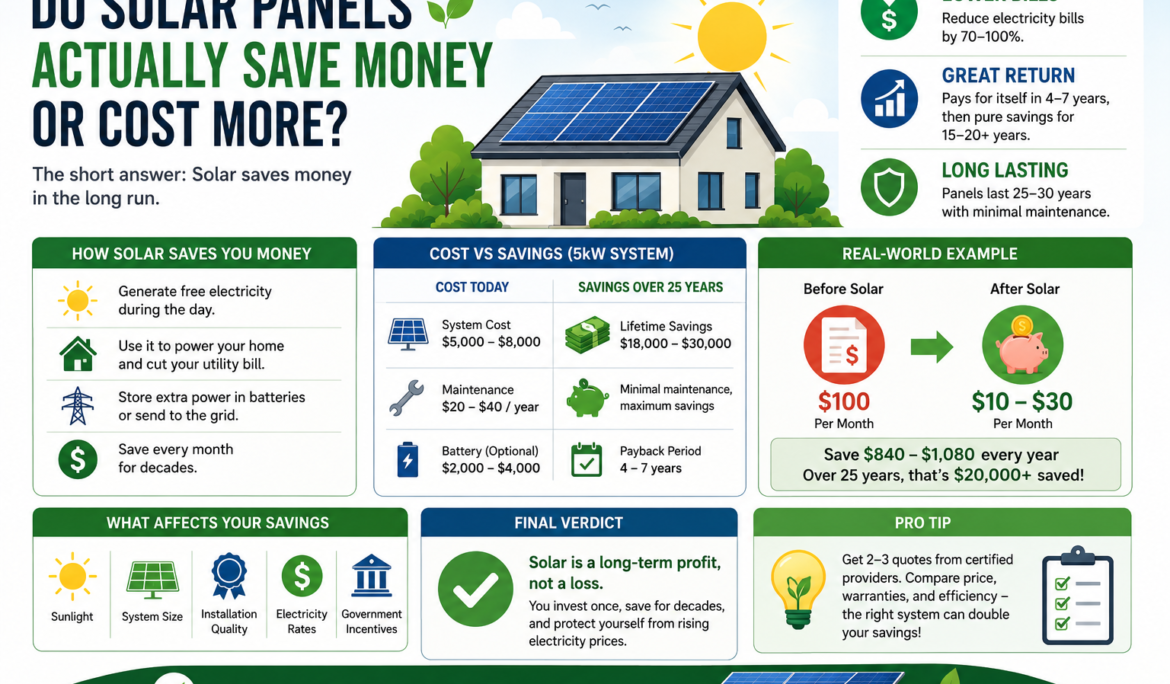
| Monthly Bills | Your electricity bills can drop by 70–100% depending on usage. |
| Long-Term ROI | Solar usually pays for itself in 4–7 years, then gives pure savings for 15–20+ years. |
| Lifespan | Panels last 25–30 years with minimal maintenance. |
| Verdict | ✅ Solar saves money long-term if installed correctly and sized to your needs. |
How Solar Panels Save You Money
Solar panels reduce or replace your need to buy electricity from the grid.
Here’s how it works:
- You generate free electricity during the day.
- You use it to power your home (cutting your utility bill).
- Extra power can be stored in batteries or sent to the grid (net metering).
- You save every month for decades.
Simple Cost vs Savings Breakdown
| Item | Average Cost (USD) | Lifetime Savings (25 Years) | Notes |
|---|---|---|---|
| Residential Solar System (5kW) | $5,000 – $8,000 | $18,000 – $30,000 | Depends on local sunlight & electricity rates. |
| Maintenance (per year) | $20 – $40 | Minimal – mostly cleaning & inspection. | |
| Battery Storage (optional) | $2,000 – $4,000 | Provides night backup & more savings. | |
| Payback Period | 4 – 7 years | After that, power is essentially free. |
Real-World Example
Let’s say your monthly electric bill is $100.
- With solar, your bill drops to around $10–$30 (grid connection fee).
- That’s $840–$1,080 saved per year.
- Over 25 years, you could save $20,000 or more, depending on rates and sunlight.
Factors That Affect Profit or Loss
| Factor | Effect | Tip |
|---|---|---|
| Sunlight / Weather | More sunlight = faster payback. | Use online solar maps to check your area’s solar potential. |
| System Size | Oversized = waste, undersized = less saving. | Get a proper energy audit before installing. |
| Installation Quality | Bad wiring or cheap panels = poor output. | Always hire certified installers. |
| Electricity Rates | Higher rates = more savings. | Solar gives better ROI where power is expensive. |
| Government Incentives | Can reduce cost by 20–40%. | Check for tax credits or subsidies in your area. |
Maintenance & Hidden Costs
Solar panels have no moving parts, so maintenance is simple.
| Task | Frequency | Cost |
|---|---|---|
| Cleaning dust & debris | 2–3 times per year | $20–$50 |
| Professional inspection | Once a year | $50–$100 |
| Inverter replacement | Every 10–15 years | $500–$1,000 |
Overall maintenance cost is less than 1% of what you save.
Solar as an Investment
| Metric | Typical Result |
|---|---|
| Return on Investment (ROI) | 12–20% annually (better than many bank savings rates). |
| Lifespan | 25–30 years. |
| Warranty | 20–25 years (power output guarantee). |
| Environmental Value | Cuts CO₂ and improves property value. |
Fun fact: Homes with solar sell for 3–5% higher prices according to Zillow studies.
Final Verdict
Solar panels are a long-term profit, not a loss.
- You recover your investment in a few years.
- You save for decades afterward.
- You protect yourself from rising electricity prices.
In short —
Solar doesn’t just pay for itself — it pays you back.
Pro Tip:
Before you install, get two or three quotes from certified providers.
Compare prices, warranties, and efficiency — the right system can double your savings.
Key Studies & Findings
| Study | Location / Context | Key Findings | Relevance to Profit/Loss Question |
|---|---|---|---|
| Design and Analysis of an On‑Grid Solar System House in Lahore, Pakistan EJECE | Residential on-grid PV system in Lahore, Pakistan | • Pay-back time ≈ 2.7 years (nominal) & ~3.1 years discounted. • Internal Rate of Return (IRR) ~32.5% in study model. EJECE | Strong evidence that in favourable conditions a solar system can return the investment quickly and move into profit mode. |
| Return on Investment (ROI) Analysis of OFF‑Grid Solar Photovoltaic System in Residential Sector of Pakistan jse.smiu.edu.pk | Off-grid residential PV systems in Pakistan (various provinces) | Pay-back periods: Sindh ~3.98 years, Baluchistan ~2.33 years, Punjab ~3.99 years, KPK ~6.78 years. jse.smiu.edu.pk | Shows variations by region (sunlight, electricity cost, system type) — still generally in a positive return zone, not loss. |
| Cost and Benefit Analysis of Solar Panels at Home IJAEMS | Residential on-grid home system in Philippines (3 kW) | • Total cost ~ ₱150,000. • Monthly savings ~ ₱2,300. • Payback period ~ 5.4 years. • 20-year savings ~ ₱402,000 (≈> 2.6× original investment). IJAEMS | A clear example of long-term profit: initial cost is recouped and followed by years of savings. |
| Full life‑cycle cost model for practical application of solar energy system SpringerOpen | 10 kWp & 100 kWp systems in Chinese market; grid-connected & off-grid cases | • Break-even / Discounted Payback Period (DPP) for some off-grid systems >20 years (i.e., borderline or negative NPV). • Grid-connected systems show consistent returns. SpringerOpen | Illustrates that context matters: system type, local cost of electricity, grid connection status all affect profit vs loss. Not all scenarios are automatically profitable. |
| Lifecycle cost and carbon implications of residential solar‑plus‑storage in California PMC | Residential PV + battery storage in California, USA | • Annual savings per household ~ US$180–$730 (depending on system, electricity rate) from PV alone. • Additional environmental & lifecycle gains. PMC | Confirms solar + storage can yield tangible cost savings, though magnitude depends on electricity tariff and system details. |